.png)

Public procurement is no longer just about cost and capability, it is increasingly a lever for climate action. At the centre of this shift sits Procurement Policy Note 06/21 (PPN 06/21), a policy that has significantly changed what it means to be a viable supplier to the UK public sector.
For organisations targeting government or NHS contracts, PPN06/21 is not optional, it is a gateway requirement. But for those who approach it strategically, it's also an opportunity to build credibility, resilience, and long-term commercial advantage.
Introduced in 2021, PPN 06/21 embeds carbon reduction and climate action into procurement decisions. It requires suppliers bidding for major public sector contracts to demonstrate a credible commitment to Net Zero. At its core, the policy ensures that suppliers are not just measuring emissions, but actively reducing them, in order to align public spending with the UK’s Net Zero target. Since 2025, the policy has been rebranded as PPN 006 under the Procurement Act, but the underlying requirements remain the same.
PPN 06/21 applies to:
For suppliers, this translates to a simple rule:
If you want to win high-value public sector contracts, you must devise a plan to get to Net Zero.
This includes sectors such as construction, facilities management, professional services, technology, and increasingly, healthcare supply chains.
To pass the PPN 06/21 selection stage, suppliers must submit a Carbon Reduction Plan (also known as CRP). A compliant CRP must include:
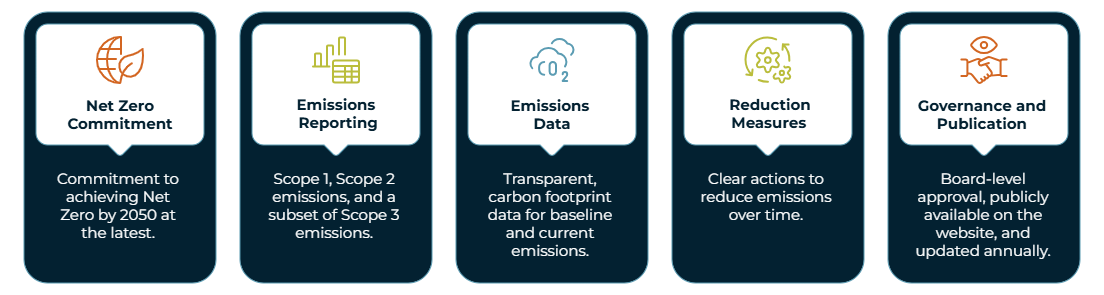
The NHS has gone further than central government in embedding carbon requirements into procurement. Today, a CRP is mandatory for high-value NHS contracts (£5m+). For lower value contracts, suppliers still need to have made a Net Zero commitment. CRPs are a pass/fail requirement in NHS tenders. This means that even organisations not traditionally exposed to central government procurement are now impacted via the healthcare supply chain.
In practice, PPN 06/21 has become the baseline expectation across NHS procurement, not just a central government requirement.
Alongside PPN 06/21, the NHS has introduced the Evergreen Sustainable Supplier Assessment, which represents a shift from compliance to continuous improvement. The Evergreen Assessment is a self-assessment platform for suppliers that provides a sustainability maturity score. It aligns suppliers with the NHS Net Zero roadmap and is increasingly required for NHS Supply Chain frameworks and medicines procurement . While PPN 06/21 answers the question: “Are you compliant?”, the Evergreen Assessment asks: “How mature and credible is your sustainability strategy?”. Beyond commitments, the assessment includes whether organisations are actively reducing emissions through defined decarbonisation initiatives, and whether climate responsibility is embedded at a senior level with clear oversight and accountability. The framework also considers the credibility of reported data, including whether the organisation’s carbon footprint has been independently verified. As maturity increases, suppliers are expected to demonstrate transparency, continuous improvement, and active engagement with their own supply chains to drive Scope 3 reductions, reflecting the NHS’s broader ambition to decarbonise its entire value chain.
Meeting PPN 06/21 is just the starting line. The real challenge is building a climate action plan. Climate Essentials enables organisations to accurately calculate their Scope 1 and Scope 2 emissions, alongside the required Scope 3 categories. All calculations are aligned with the Greenhouse Gas Protocol and UK reporting standards, meaning the result is a reliable dataset that forms the backbone of a compliant and defensible Carbon Reduction Plan.

Building on this, Climate Essentials transforms Carbon Reduction Plans from static, one-off documents into dynamic, structured outputs. Organisations can generate dynamic CRPs efficiently, update them annually with minimal manual effort. This significantly reduces the administrative burden while increasing confidence in the integrity of reported data.
Beyond compliance, the platform supports a transition towards strategic carbon management. Organisations are able to set science-aligned reduction targets, including Net Zero by 2050 in line with the UK commitments.
As expectations expand within the healthcare sector, Climate Essentials also supports alignment with NHS requirements, including readiness for the Evergreen Sustainable Supplier Assessment.
Finally, for organisations with complex supply chains, Climate Essentials enables effective supplier engagement. It provides the tools to collect and standardise Scope 3 data, improve data quality across value chains, and support suppliers in their own emissions measurement and reduction efforts. In this way, Climate Essentials does not simply support compliance, it provides the infrastructure for organisations to compete, adapt, and lead in a rapidly evolving low-carbon economy.
PPN 06/21 has shifted sustainability from a “nice to have” to a commercial prerequisite. And increasingly, in sectors like healthcare, this is not just about winning contracts, it is about remaining eligible to compete at all. PPN 06/21 is often seen as a compliance burden. In reality, it is a signal of where procurement, and the economy, is heading.
The question is no longer: “Do we need a Carbon Reduction Plan?” But: “Do we have the systems, data, and strategy to compete in a Net Zero economy?”


.jpg)
.jpg)
.jpg)





.jpg)